

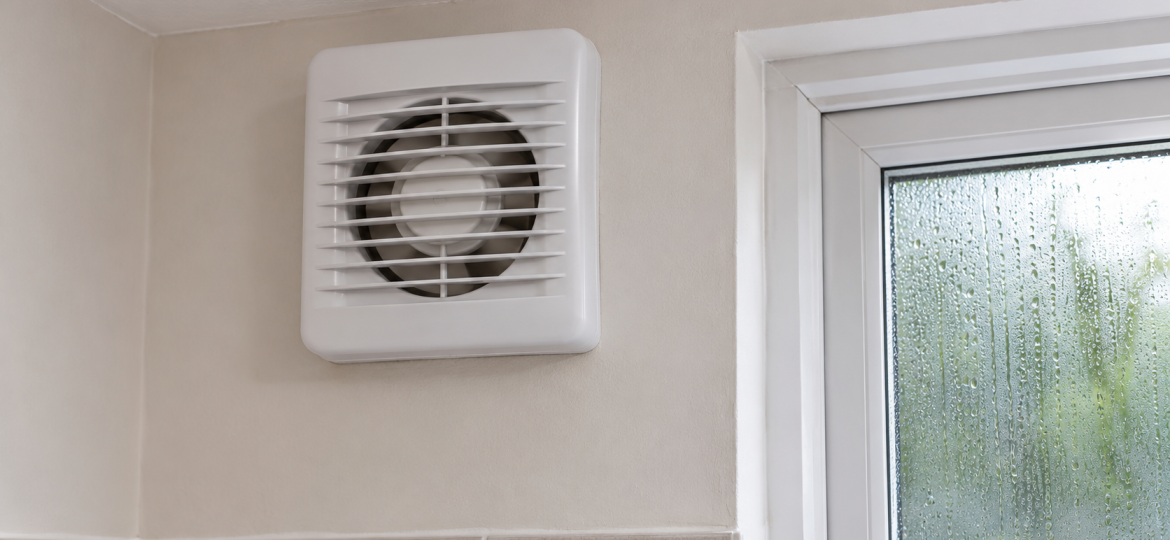
Is Your Extractor Fan Pulling Its Weight?
Cooking, showering and everyday living introduce moisture into our homes. A correctly selected and installed extractor fan removes humid air at source, helping to control condensation and reduce the conditions that encourage mould. However, a fan is only as effective as its installation, ducting and maintenance.
What does Part F require?
In England, Building Regulations Part F requires adequate ventilation. Approved Document F provides guidance on achieving this. Under the 2021 edition, typical minimum intermittent extract rates are:
- Kitchen: 30 litres per second through an externally ducted cooker hood adjacent to the hob, or 60 litres per second where extraction is elsewhere.
- Utility room: 30 litres per second.
- Bathroom or shower room: 15 litres per second.
- Separate WC: 6 litres per second.
These are installed airflow rates, not simply the figures printed on the fan’s packaging. Continuous extract systems have different requirements and must also satisfy whole-dwelling ventilation needs. Extraction should discharge outdoors; a recirculating cooker hood does not remove moisture or provide the required extract ventilation. Appropriate replacement-air provision, controls, commissioning and user instructions are also important.
What about continuously running fans?
Under England’s Approved Document F, Volume 1 (2021 edition), continuous mechanical extract systems (including suitably designed decentralised systems) run continuously at a background rate and provide increased extraction when needed. The minimum high (boost) extract rates are:
- Kitchen: 13 litres per second.
- Utility room: 8 litres per second.
- Bathroom or shower room: 8 litres per second.
- Separate WC: 6 litres per second.
Boost rates versus continuous trickle: The figures above are minimum high (boost) rates, not universal continuous trickle settings for each room. The combined background extraction must meet the whole-dwelling ventilation requirement, determined by bedroom numbers and floor area. If a room’s continuous extract rate already meets or exceeds its minimum high rate, no additional boost is needed for that room; the whole-dwelling requirement must still be satisfied.
A fan in one room is only part of the picture, your whole home needs ventilation. Part F guidance sets a whole-dwelling ventilation requirement based on floor area and bedroom numbers. For continuous extract systems, the combined background airflow must meet that requirement: meeting individual room boost rates alone is not enough.
Quick airflow conversion: To convert litres per second (l/s) into cubic metres per hour (m³/h), multiply by 3.6. For example, 8 l/s = 28.8 m³/h, 13 l/s = 46.8 m³/h and 15 l/s = 54 m³/h. To convert back to l/s, divide by 3.6.
Good extractor fan installation makes the difference
- Match the fan to the job: Select it for the required airflow and the resistance of the complete duct route. Longer or more restrictive runs may need a mixed-flow or centrifugal fan rather than a basic axial model.
- Keep ducting short and direct: Length, diameter, duct type and route all affect performance. Long runs, sharp bends and restrictive external grilles increase resistance and reduce the air actually extracted.
- Choose smooth ducting: Prefer correctly sized rigid, smooth-bore ducting. Keep flexible sections short, fully extended and supported; avoid crushed sections, sagging and unnecessary reducers. Seal joints and use gentle bends wherever possible.
- Plan the outlet and air supply: Discharge outside, never into a loft or cavity. Provide suitable replacement-air and room-to-room transfer paths. Insulate ductwork through cold spaces and manage condensation in accordance with the system design and manufacturer’s instructions.
Efficient operation and regular cleaning
Choose a quiet, energy-efficient fan that delivers the required installed airflow. Suitable humidity controls or an overrun timer can help intermittent fans remove moisture after use. Fans designed for continuous ventilation should remain running at their intended settings rather than being routinely switched off.
Extractor fans need regular cleaning. Dust, fluff and grease can obstruct grilles, filters and fan components, reducing airflow and increasing noise. Check them routinely and clean at the manufacturer’s recommended intervals, more often where build-up occurs quickly. Isolate the electrical supply before any permitted cleaning, follow the instructions and leave inaccessible ductwork or internal servicing to a competent person.
The bottom line: A powerful fan cannot compensate for poorly designed ducting. Correct selection, a short and smooth duct route, verified airflow and regular maintenance are the keys to effective domestic extraction.
10 top tips for extractor fan installation
- Select the right fan: Match its performance to the required airflow and resistance of the complete duct route.
- Extract near the moisture source: Position the fan inlet to capture humid air effectively, following the manufacturer’s siting guidance.
- Discharge outdoors: Never terminate extraction in a loft, ceiling void or cavity.
- Keep the route short: Minimise duct length and use as few bends as practicable.
- Use the correct duct size: Follow the fan specification and avoid unnecessary reducers.
- Prefer smooth, rigid ducting: Keep flexible sections short, fully extended and free from crushing or sagging.
- Seal and support ductwork: Secure joints and provide supports to prevent leaks and movement.
- Manage condensation: Insulate ducts through cold spaces and follow the specified drainage arrangements.
- Provide replacement air: Keep the designed air inlets and room-to-room transfer paths unobstructed.
- Select the correct outlet grille: Choose a grille compatible with the fan and duct size. Gravity shutters help prevent backdraughts when the fan is off; check that they open freely at the intended airflow, including continuous trickle settings.
England’s Approved Document F, Volume 1 (2021 edition), runs to 62 pages, so it is understandable if ventilation requirements feel complex. While much of the guidance focuses on new homes, it also covers work on existing dwellings. Its principles remain relevant to achieving good air exchange and managing moisture in your home.
Don’t let condensation dictate how you live in your home. If streaming windows, persistent moisture or ineffective extraction sound familiar, call Condenex today for sound, honest advice. You don’t need to work through 62 pages of ventilation guidance to take the next step. Talk to us about your concerns and let us help you understand what could be contributing—and the practical options for improving ventilation in your home. Professional-grade extractor fans are also available to purchase directly from the shop section of our website.
Guidance note: the airflow figures above refer to the 2021 edition of Approved Document F for England. A 2026 edition has also been published, with implementation dates in 2027. Check which edition and transitional arrangements apply to your building work.
For further homeowner advice, read the Energy Saving Trust’s guide to home ventilation.
Get advice on extractor fans and condensation
For help with a property in Somerset or Dorset, arrange a free condensation assessment, call 0800 074 0586 or email info@condenex.co.uk.